

Mother of the bride outfits with jackets offer two different coverage options: the look with the outer layer on, and the look underneath. Compare both before ordering, because a long jacket can sit over a sleeveless top, sheer sleeves can leave skin visible, and an open front may never cover the chest.
The best starting point is the coverage you want during the ceremony, dinner, and dancing. Then check how each piece of the outfit meets that goal, rather than relying on the word “jacket” alone.
Key Takeaways
| Check | Why it matters |
|---|---|
| Map the jacket and inner layer separately | Removing a jacket may reveal a sleeveless top or a different neckline. |
| Look at fabric between the decorations | Lace and sheer panels can provide visual coverage without being opaque. |
| Confirm the pieces included | A pantsuit title does not explain whether the outfit is one, two, or three pieces. |
| Check standing, sitting, and reaching | A jacket can open or move away from the body during ordinary wedding activities. |
What does the jacket actually cover?
Start with your shoulders
A jacket that rests on the shoulder can add coverage above a narrow-strapped or sleeveless inner layer. Check whether the fabric reaches from the neckline to the sleeve seam, and whether there are cutouts or open lace sections between them.
Look for a straight-on photograph with the model’s arms relaxed. A hand on the hip can pull an open jacket into a position it may not hold while you walk down the aisle or stand beside the couple.
For a ceremony with specific clothing expectations, ask the venue about the exact requirement. Shoulder coverage, an opaque upper arm, and a covered neckline are separate details, so a general “modest” label cannot settle all three.
Follow the sleeve to its endpoint
Three-quarter sleeves leave the lower arm visible, while long sleeves reach farther toward the wrist. Neither label tells you whether the sleeve is lined, open lace, or sheer fabric.
Decide whether you want a soft outline over the arm or fabric that hides the skin beneath. Those are equally valid preferences, but they call for different products and different questions before you buy.
Check the inside of the elbow as well as the outside of the arm. A slit sleeve or a loose cuff can expose more skin when you bend your elbow than the front photograph suggests.

Check the open front and the back
An open-front jacket usually frames the inner top rather than covering it completely. If you want a higher neckline, choose an inner piece that already gives you that coverage; do not count on the jacket edges staying together.
At the back, compare the jacket’s neckline and hem with those of the inner layer. A longer outer piece may cover the waist and seat while leaving the upper back visible through lace or a low back opening.
Look beyond decorative appliques. Dense motifs can cover selected areas while the fabric between them remains transparent, so the overall impression of a covered back may differ from its actual opacity.
Will you like the outfit with the jacket off?
Read the inner top as a separate garment
Imagine putting the jacket on a chair before dinner. Would you feel comfortable wearing the remaining outfit on its own? Check its straps, armholes, neckline, and back instead of treating it as an unfinished layer.
A sleeveless inner top can be a useful option if you prefer changing your coverage through the day. If you want your upper arms covered throughout the celebration, a jacket-off photograph is a crucial part of your comparison.
You do not have to plan to remove the jacket. Choosing to keep it on is just as reasonable; the point is to know which layer provides the coverage you want.
Confirm how many pieces you receive
Some outfits combine a top, pants, and jacket. Others pair a dress with a jacket, or use a single garment beneath an outer layer. These arrangements can look similar in a small product image.
Read the included-pieces description before ordering. Do not assume a jacket, belt, or decorative accessory is included simply because it appears in the styling photograph.
If a title says “jumpsuit” but the description discusses separate pants and a top, ask which construction you will receive. The answer affects both coverage and how you can wear the outfit during the day.
Let the wedding guide the combination
A jacket does not make an outfit automatically more appropriate for your role or age. Choose the dress, pants, and coverage you enjoy, then check that the overall formality agrees with the couple’s plans.
Emily Post’s guidance for the mothers of the couple allows a range of outfits, including dresses and skirt-and-jacket ensembles, when they suit the wedding’s style. That supports choosing the combination around the occasion and your preferences.
Unless the couple specifically requests it, generally avoid white, ivory, cream, and all-white lace as a wedding guest. Discuss any color that may resemble the wedding dress with the couple before committing.
Which fit checks matter for a layered outfit?
Give both layers room to work
The inner garment and jacket must fit at the same time. A comfortable inner top can still feel restricted beneath a narrow jacket, while a jacket that pulls across the back may slide away from the front.
Compare your current measurements with the product’s own chart and the Babyonlinewholesale size guide. Ask about individual pieces when a set uses one size selection for the whole outfit.
Do not automatically size up every layer for extra coverage. Excess fabric can change where a shoulder seam sits or how the front hangs; the useful question is whether the intended size provides the movement you need.
Check three ordinary movements
Use a three-position review: standing with relaxed arms, sitting at a table, and reaching forward as if greeting someone. This is a comparison method, not a promise about how any particular garment will perform.
Watch for the jacket front spreading, sleeves pulling above their expected endpoint, or the back becoming tight. If photographs do not show these positions, ask for clarification about the construction and relevant measurements.
At home, you can use a jacket you already like to identify the coverage you prefer. Its measurements are a useful question prompt, although a different fabric or cut will not necessarily fit the same way.

Compare where the jacket ends
A shorter jacket can leave the inner waistline and the top of the skirt or pants visible. A longline jacket creates another layer over those areas, but its open front still allows the inner outfit to show.
Look at the side view while seated, especially if you want coverage over the hips or seat. The hem can shift with your posture, and a curved or split jacket hem may reveal more at the sides than at the center back.
Think about the wedding activities you actually expect: holding flowers, hugging family, raising a glass, or sitting through dinner. These give your coverage questions a practical purpose without turning the outfit into a list of restrictions.
How to compare Babyonlinewholesale jacket sets
Start with the mother of the bride pantsuit collection for layered sets, then compare the mother of the bride dress collection if you prefer a skirt beneath the jacket.
The women’s jumpsuits collection also contains outfits worth checking individually. Collection placement and product names do not replace the included-pieces description.
For example, the Plus Size Three-Piece Mother of the Bride Pantsuit describes a sleeveless inner top, a three-quarter-sleeve floral lace jacket, and pants. That makes it a useful reminder to assess the inner and outer layers separately.
Other listed sets use an open-front longline jacket. Compare where that outer layer ends and whether its sleeves are sheer, instead of assuming every three-piece outfit offers the same arm or back coverage.
Save the exact product link and ask about any unclear detail before ordering. If the photograph, title, and specification table differ, request confirmation for that product and color rather than borrowing information from a similar set.
For a broader comparison of garment types, read when a pantsuit may suit your plans. The separate boho mother of the bride guide considers sleeves, length, and outdoor venues.
Shop the Look: Compare the Layers
Use these outfits as starting points for a piece-by-piece comparison. Check the current product page for available selections and confirm the jacket, inner layer, and lower garment included in your order.
Three-Piece Pantsuit With a Lace Jacket

The listing pairs a sleeveless inner top with a three-quarter-sleeve lace jacket and pants. Compare the outer layer with the inner top so you know which areas stay covered when the jacket comes off.
Pantsuit With an Open-Front Duster Jacket
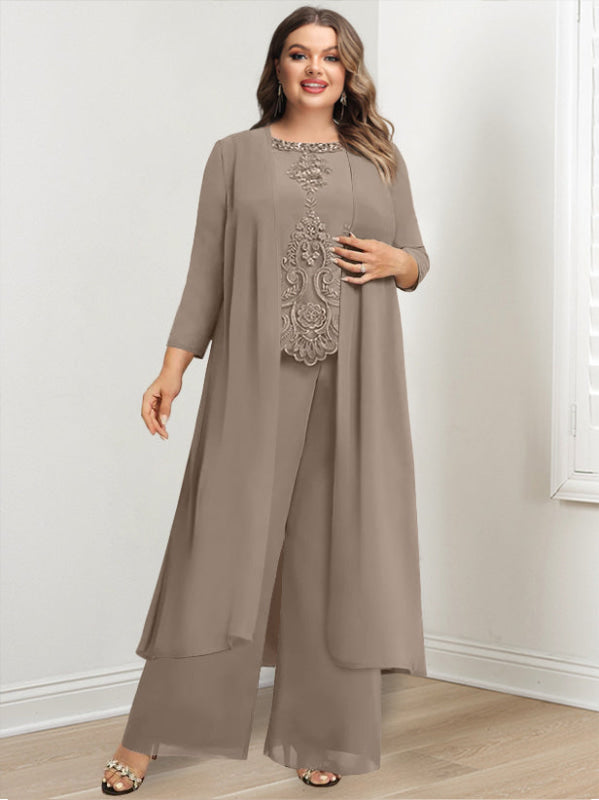
This set describes a long open-front jacket, embellished sleeveless top, and wide-leg trousers. Use it to compare longline back coverage with a shorter jacket, while checking the sheer sleeves separately.
Ankle-Length Pantsuit With a Longline Jacket

The long jacket sits over an asymmetric-hem top and ankle-length pants. The open front keeps the inner layer visible, so assess that neckline and hem as part of the complete outfit.
Two-Piece A-Line Dress With a Matching Jacket

Compare this skirt-based set with the pantsuits above. The gray jacket opens over the dress, giving a clear view of how the outer edges frame the neckline rather than closing across it.
Square-Neck Dress Set With a Jacket

This listing combines a floor-length dress and coordinating jacket. Compare its shorter outer-layer hem with the longline options, and check the sleeveless inner dress shown in the product gallery if you plan to remove the jacket.
Ankle-Length Sequin Dress Set
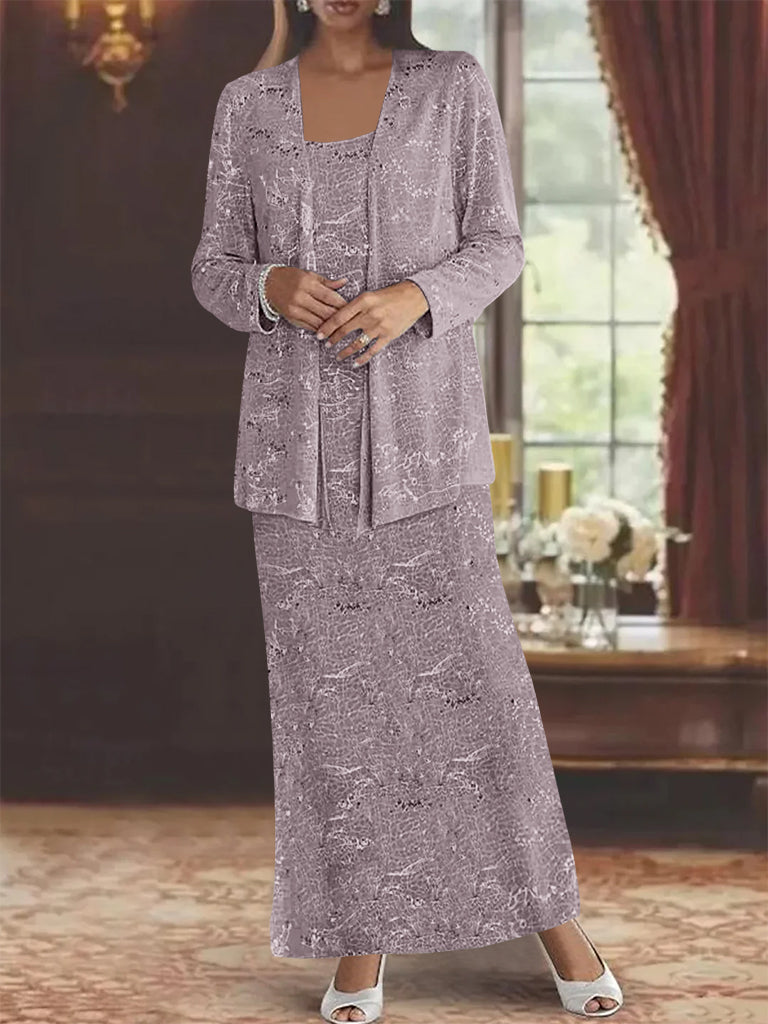
The pictured jacket and dress provide another layered arrangement to compare. Check the separate sleeveless dress image on the product page, then decide whether both versions meet your preferred coverage.
Frequently Asked Questions
Does a mother of the bride outfit need a jacket?
No, a jacket is a personal choice rather than a requirement for the role. It can give you another coverage option when the wedding’s plans and your preferences make layering useful.
Will a lace jacket completely cover my arms?
It may cover the outline of your arms while leaving skin visible through the lace. Check the spaces between motifs and whether the sleeves have a separate lining.
Can I remove the jacket during the reception?
You can plan for that when the outfit underneath offers coverage you are comfortable with. Confirm the inner garment’s neckline, sleeves, and back before you rely on a jacket-off option.
Does “three-piece” always mean top, pants, and jacket?
Do not assume the pieces from the label alone. Read the product’s included-items description and clarify any difference between its title and detailed specifications.
What should I check if the jacket pulls across my back?
Review the jacket’s measurements and movement room rather than expecting the inner layer to solve the fit. Pulling can change how the front sits and how much coverage remains when you reach.
Where should I start comparing jacket outfits?
Begin with the mother of the bride pantsuit collection and compare each set’s actual components. Choose the jacket and the outfit beneath it for the coverage you want throughout the wedding.
About the Author
Lily
Lily is a bridal fashion blogger specializing in wedding dresses, evening gowns and homecoming dresses. She loves decoding fashion trends and offering down‑to‑earth dress‑shopping tips to help women shine on their special days.